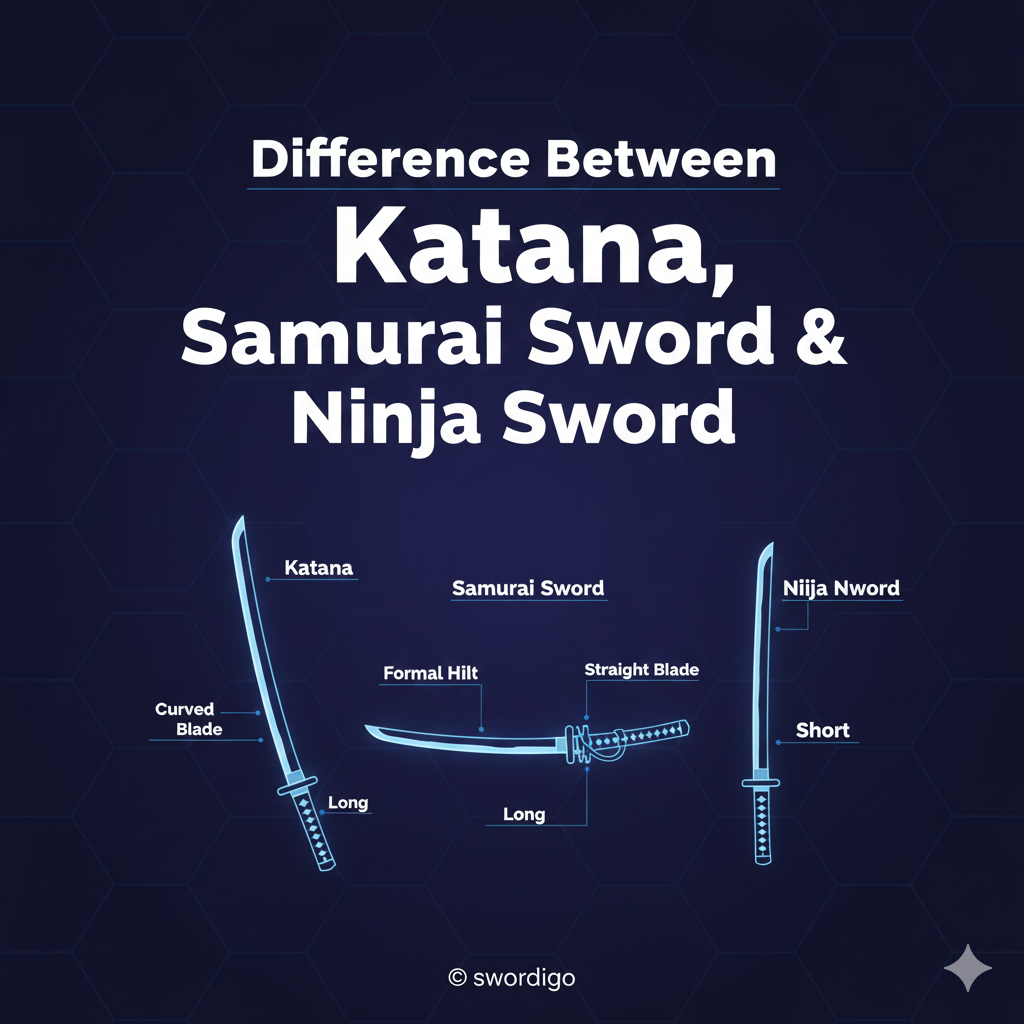
Katana vs Samurai Sword vs Ninja Sword: What’s the Difference?
Introduction
Japanese swords have fascinated people around the world for centuries. Among the most commonly discussed terms are Katana, Samurai sword, and Ninja sword.
Although these terms are often used interchangeably, they do not necessarily describe the same thing. Their meanings are connected to different aspects of Japanese history, culture, terminology, and popular culture.
In this guide, we’ll explore:
-
What a Katana is
-
What the term “Samurai sword” means
-
What is commonly meant by “Ninja sword”
-
The historical and cultural differences between them
-
How these terms are used today
What Is a Katana Sword?
A Katana is a traditional Japanese sword characterized by its distinctive curved profile, single-edged blade, handle, guard, and scabbard.
Historical Katana varied in size, proportions, construction, and appearance depending on their period and maker.
Common characteristics include:
-
Curved blade profile
-
Single-edged design
-
Long handle
-
Traditional Japanese fittings
-
Distinctive scabbard known as a Saya
The Katana is strongly associated with Japanese history and Samurai culture and is now widely recognized as a symbol of Japanese craftsmanship and heritage.
What Does “Samurai Sword” Mean?
The expression “Samurai sword” is generally a broad modern term rather than the precise historical name of one specific sword type.
Samurai used different types of Japanese swords during different historical periods, including:
-
Katana
-
Wakizashi
-
Tachi
Therefore, the phrase “Samurai sword” can refer to several different traditional Japanese sword forms.
The Daisho
The term Daisho refers to the pairing of a long sword and a short sword.
A commonly recognized pairing consisted of:
-
Katana — long sword
-
Wakizashi — shorter sword
The pairing became strongly associated with Samurai identity during certain periods of Japanese history.
What Is a Ninja Sword?
The phrase “Ninja sword” is commonly used today to describe a sword associated with the popular image of the Ninja or Shinobi.
However, the historical evidence for a standardized sword type specifically designed for Ninja is limited and remains a subject of historical discussion.
Many modern representations of the Ninja sword come from:
-
Movies
-
Television
-
Anime
-
Manga
-
Video games
-
Popular fiction
These portrayals often show a straight-bladed sword with simple fittings, but this image should not automatically be treated as a definitive historical description.
Katana vs. Samurai Sword vs. Ninja Sword
| Feature | Katana | Samurai Sword | Ninja Sword |
|---|---|---|---|
| Meaning | Specific Japanese sword type | Broad modern expression | Mostly a popular-culture term |
| Historical association | Japanese sword tradition | Samurai culture | Shinobi/Ninja imagery |
| Blade appearance | Traditionally curved | Varies by sword type | Often portrayed as straight |
| Historical evidence | Well documented | Refers to multiple sword types | Limited evidence for a standardized type |
| Modern use | Collecting, study and display | Cultural and decorative use | Popular culture and display |
| Cultural association | Japanese craftsmanship | Samurai heritage | Ninja imagery and fiction |
Understanding the Difference
Katana
Katana is the most specific of the three terms. It refers to a particular type of traditional Japanese sword.
Its distinctive shape and fittings have made it one of the most recognizable examples of Japanese craftsmanship.
Samurai Sword
Samurai sword is a broader expression. It can refer to different swords historically associated with Samurai, depending on the context.
Therefore, saying “Samurai sword” does not necessarily identify one exact sword design.
Ninja Sword
Ninja sword is a term heavily influenced by modern popular culture.
While Ninja and Shinobi are important parts of Japanese history, the idea of one standardized “Ninja sword” is not as clearly established in historical sources as the traditional Katana.
Cultural Importance
Each term has a different cultural association.
The Katana is strongly connected with Japanese sword-making traditions and Samurai history.
The term Samurai sword represents the broader historical relationship between Japanese swords and Samurai culture.
The Ninja sword, meanwhile, has become particularly prominent through modern entertainment and popular culture.
Understanding these distinctions helps separate historical terminology from modern interpretations.
Katana in Modern Collecting and Display
Today, Katana-inspired pieces are popular among collectors and people interested in Japanese culture and design.
They may be appreciated for:
-
Traditional Japanese aesthetics
-
Craftsmanship
-
Historical interest
-
Decorative presentation
-
Cultural symbolism
-
Collection and display
Modern display pieces can vary significantly in materials, construction, decoration, and intended presentation.
Always follow applicable local laws and regulations concerning the ownership, possession, transportation, and display of any sword or sword-like object.
Which Style Is Right for a Collection?
For a modern collection or display, the choice often comes down to personal aesthetic preference and interest.
Katana-Inspired Display
Suitable for people interested in:
-
Traditional Japanese aesthetics
-
Samurai-era history
-
Classic Japanese design
-
Traditional craftsmanship
Samurai-Themed Display
Suitable for people interested in:
-
Samurai culture
-
Japanese history
-
Traditional decorative arts
-
Historical-inspired interiors
Ninja-Themed Display
Suitable for people interested in:
-
Japanese popular culture
-
Anime and manga
-
Movies and entertainment
-
Ninja-inspired designs
Why Are Katana So Recognizable?
The Katana has become one of the world’s most recognizable symbols of Japanese sword craftsmanship.
Its distinctive silhouette, traditional fittings, historical association, and cultural significance have helped make it popular in museums, collections, films, anime, games, and decorative displays.
Conclusion
The terms Katana, Samurai sword, and Ninja sword are related but should not automatically be treated as interchangeable.
A Katana is a specific traditional Japanese sword type. “Samurai sword” is a broader modern expression that can refer to several swords associated with Samurai history. “Ninja sword” is largely a modern term influenced by popular representations of Ninja culture, with limited historical evidence for a single standardized sword design.
Understanding these differences makes it easier to appreciate Japanese sword history, craftsmanship, and cultural heritage without confusing historical terminology with modern popular culture.